
Introduction: Understanding Vacuum Levels
A vacuum is defined as an area with a pressure lower than that of the atmosphere, which is approximately 1,013 mbar at sea level. The phrase encompasses a range of magnitudes spanning twelve orders of magnitude in real-world applications, from the slight suction within a food container to the practically empty accelerator beam pipe.
Remaining gas has the potential to oxidize surfaces, deflect electron beams, and contaminate thin films, therefore the level is important. So, engineers classify vacuum as either rough, high, or ultrahigh vacuum (UHV). Changes to the system's pumps, chamber materials and seals, pump-down time, and cost occur with each pressure step down.
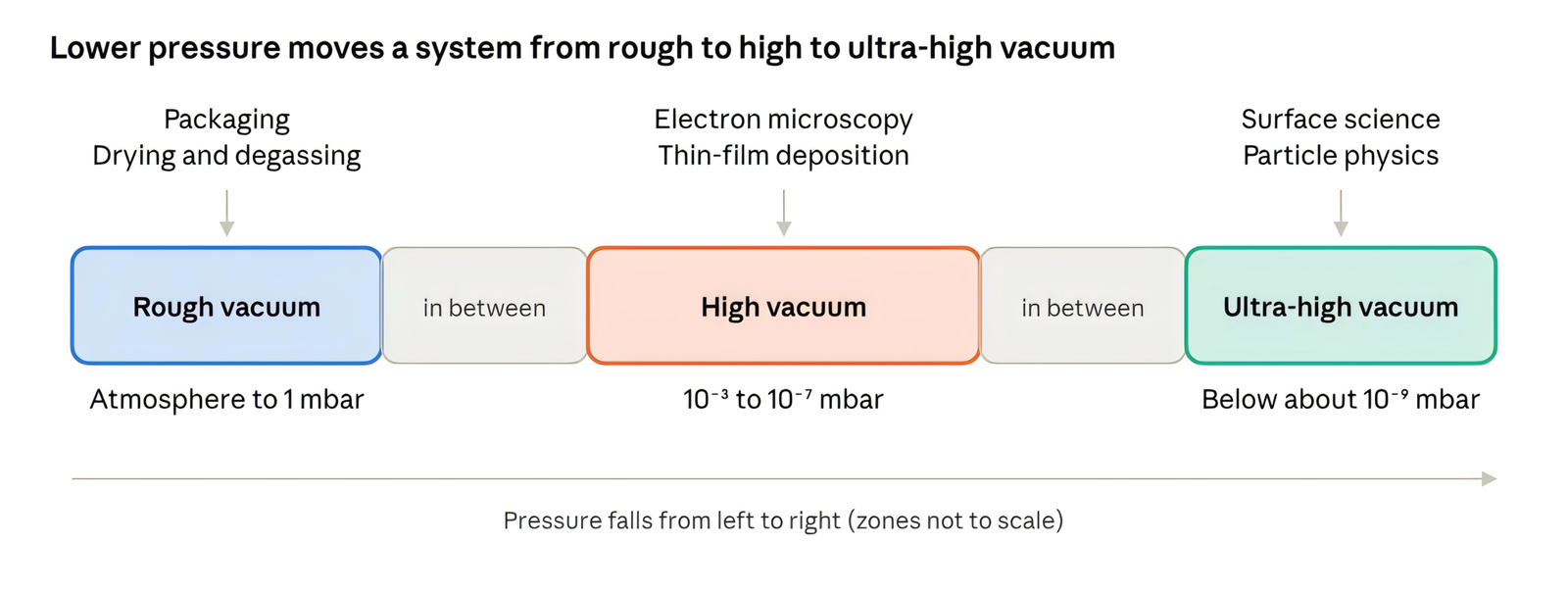
Figure 1: Vacuum ladder · 3 levels
What Determines a Vacuum Level?
The pressure of the remaining gas per unit area, as measured from zero instead than the surrounding atmosphere, is known as the vacuum level, and it is expressed as absolute pressure. The number of gas molecules decreases as the absolute pressure drops. Most datasheets include three units.
Different units of measurement are used in different contexts; the SI uses the pascal (Pa), industrial catalogs often use the millibar (mbar), and older and North American literature uses the torr. There are 760 torr, 1,013.25 mbar, or 101,325 Pa in an atmosphere, and 100 Pa, or 0.750 torr, in one millibar.
Two physical concepts aid in describing system behavior when pressure alone is insufficient. An average molecule's mean free route is the distance it travels before colliding with another molecule. In a harsh vacuum, gas moves like a fluid due to the continual collisions of its molecules. Molecules hit the chamber walls significantly more frequently than each other as the pressure decreases, causing the path to widen.
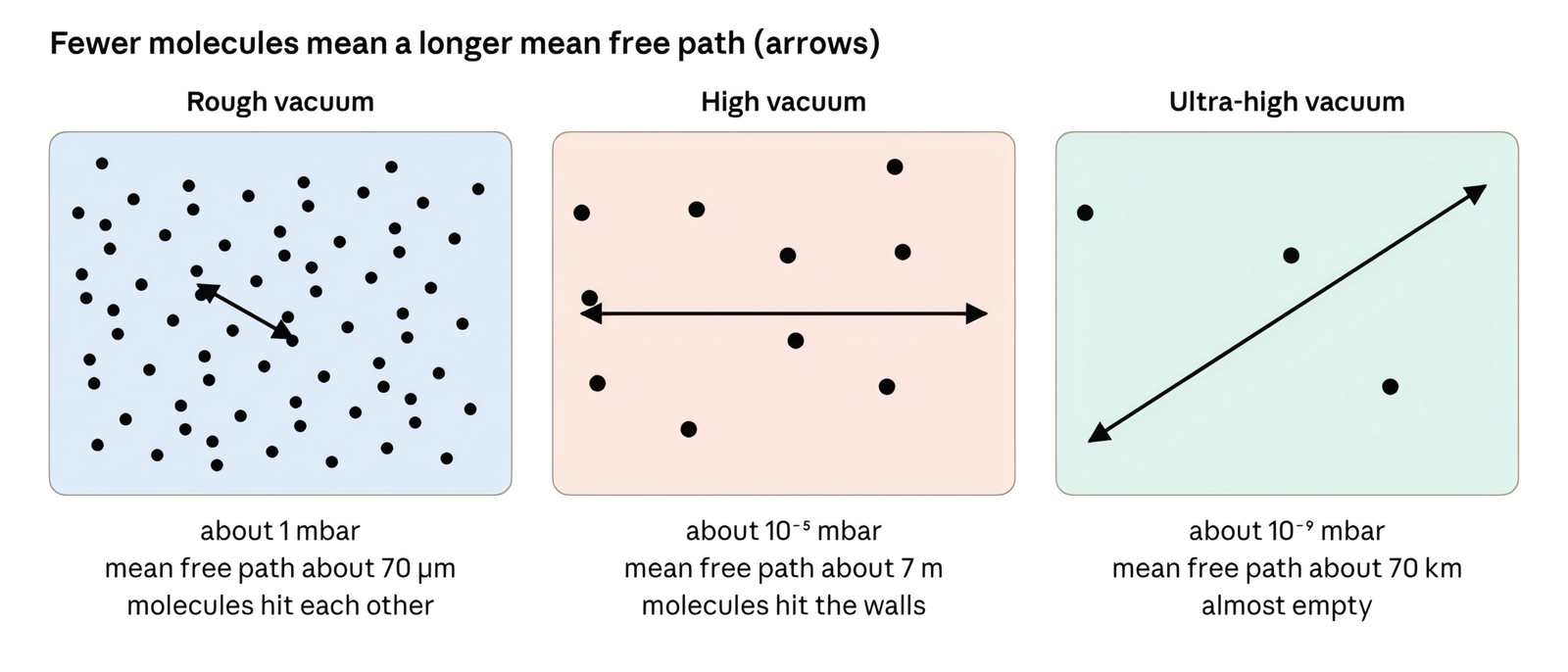
Figure 2: Gas molecules and mean free path · 3 levels
Rough Vacuum: Characteristics and Applications
Low vacuum, or rough vacuum, is defined as the pressure below atmospheric pressure, which is approximately 1 mbar. Here, gas continues to act as a continuous fluid, and typically, all that is needed is a single mechanical pump to reach the objective.
Three mechanical pump types dominate. Oil-sealed rotary vane pumps sweep gas through an oil-sealed cavity and reach about 10⁻³ mbar in two-stage form. Dry scroll pumps trap gas between two interleaved spirals, reach about 10⁻² mbar and stay oil-free. Diaphragm pumps use a flexing membrane, reach about 1 mbar and resist chemicals well.
Advantages. Rough vacuum systems are quick to pump down, easy to use, and cheap. Common materials like plastic or aluminum are commonly adequate for seals, which are often elastomer O-rings.
Common applications include preparatory pumping, which gets a chamber ready for a high-vacuum pump, drying and degassing, which involves removing air around a product, and vacuum packing, which removes air from the surrounding area.
Limitations. Since there is still a lot of gas at 1 mbar, procedures requiring long, mean free routes or extremely clean surfaces are not good candidates for rough vacuum. Those procedures necessitate advancement.
High Vacuum: Achieving Lower Pressures
High vacuum typically spans 10⁻³ to 10⁻⁷ mbar. The mean free path now exceeds the size of most chambers, so molecules travel from wall to wall in straight lines. This is the molecular flow regime, and it is why electron beams and evaporated atoms can cross a chamber without colliding with gas.
At its lowest point, this range is inaccessible with just a mechanical pump. In order for the high-vacuum pump to perform, it is connected in series with a backing pump. The backing pump is responsible for roughing up the chamber and keeping the exhaust pressure low.
Turbomolecular pumps use fast spinning blades to push molecules toward the exhaust. They are clean and quick to start, but they need a backing pump and are sensitive to shock and particles. Diffusion pumps use a jet of hot oil vapour. They offer high pumping speed at moderate cost, but oil can backstream into the chamber without baffles or traps.
At this stage, chamber design is more important. Construction workers frequently use helium to inspect joints for leaks, which are innocuous in a smooth system but reduce pressure. Surfaces are cleansed and degreased, and substances like certain greases and plastics that have a high vapor pressure are avoided. Instead of using regular rubber, you can use fluoroelastomer or metal seals; typical materials include glass, stainless steel, and aluminum.
Typical applications include electron microscopy, which needs a clear beam path; thin-film deposition, which needs clean transfer of coating material; and surface analysis, which needs few collisions between probe particles and gas.
Designing and monitoring high-vacuum systems is more complex than rough ones. A well-defined venting procedure, pressure gages, and interlocks ensure the safety of the pump and process.
Ultra-High Vacuum (UHV): Extreme Vacuum Conditions
Ultra-high vacuum refers to pressures below roughly 10⁻⁹ mbar, though some sources place the boundary at 10⁻⁷ mbar. At these pressures a freshly cleaned surface stays clean for minutes to hours instead of fractions of a second.
In ultrahigh vacuum systems, a turbomolecular pump is typically used in conjunction with oil-and part-free pumps. By ionizing gas and encasing it in a getter plate, ion pumps provide vibration-free, continuous pumping. In order to bind active gasses, like hydrogen, at high speeds, non-evaporable getter (NEG) pumps require a reactive alloy. Since they are not capable of pumping noble gasses, a little ion pump is frequently included with them.
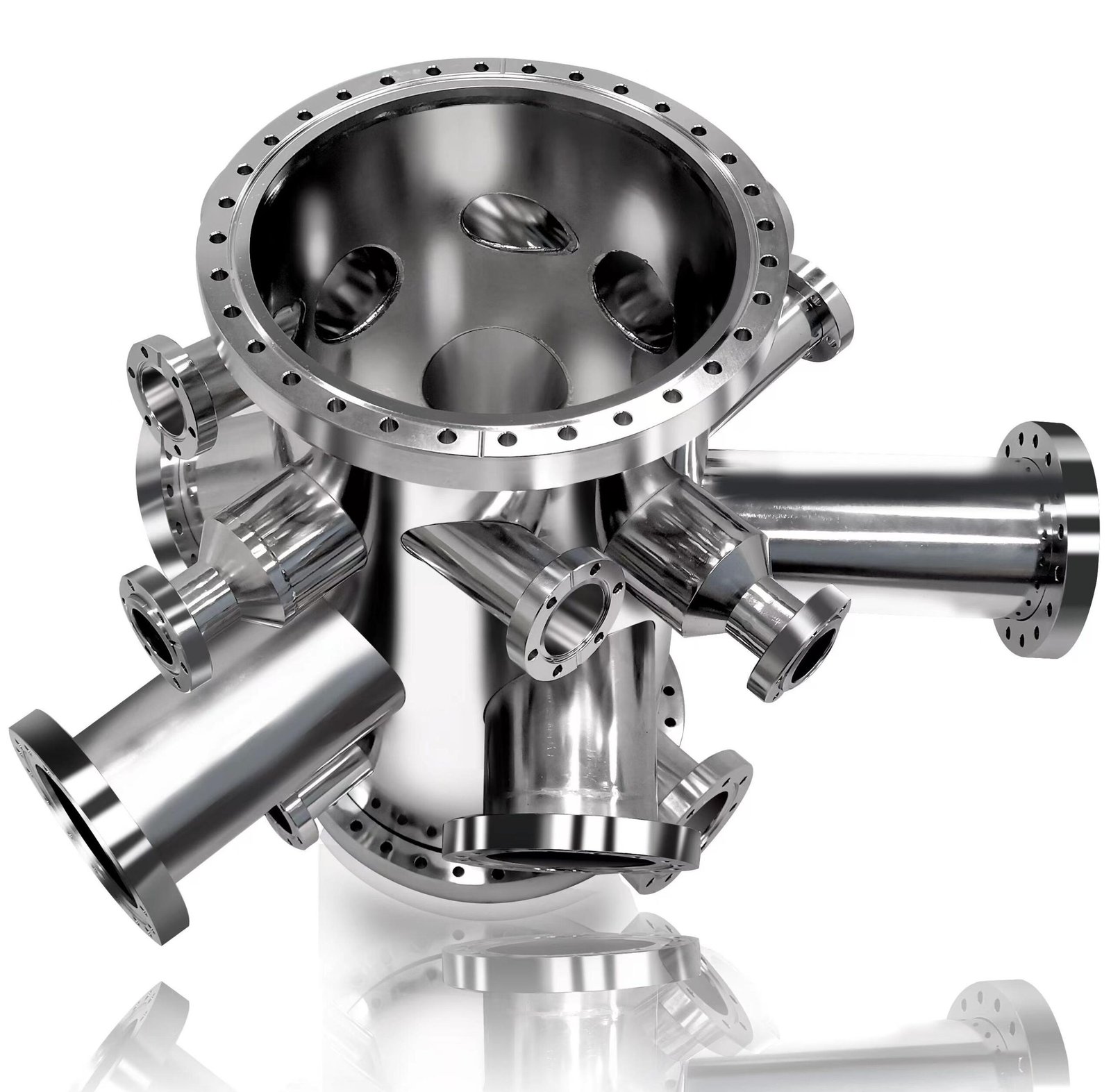
Every material in the chamber is chosen for low outgassing. Stainless steel is standard, and flanges use metal gaskets, typically copper in knife-edge seals, because elastomers outgas and let gas permeate through. Before use, the system is baked at an elevated temperature, typically 120 to 250 °C for many hours or days, to drive adsorbed water off the walls.
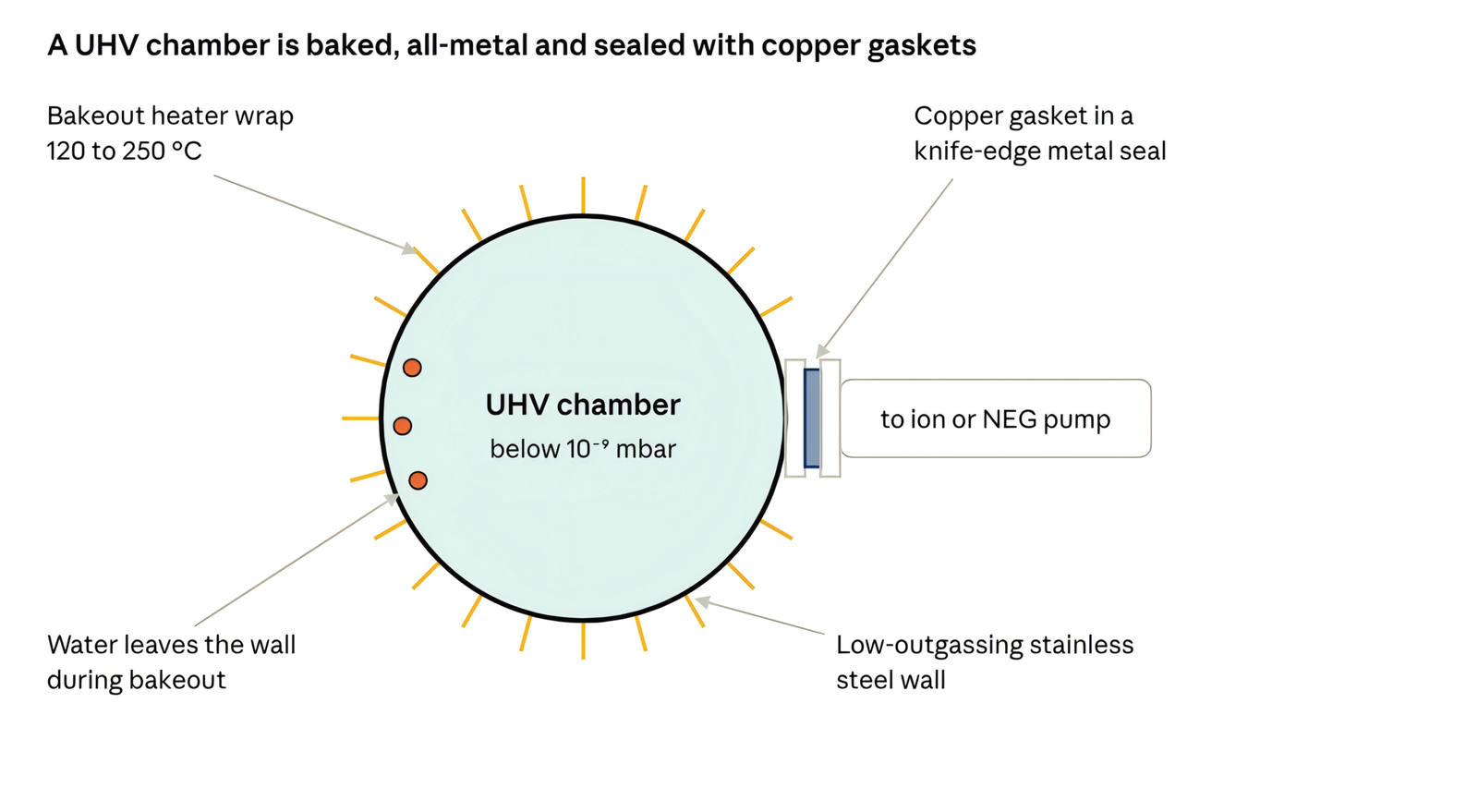
Figure 3: UHV chamber · bakeout, metal seal, getter or ion pumping
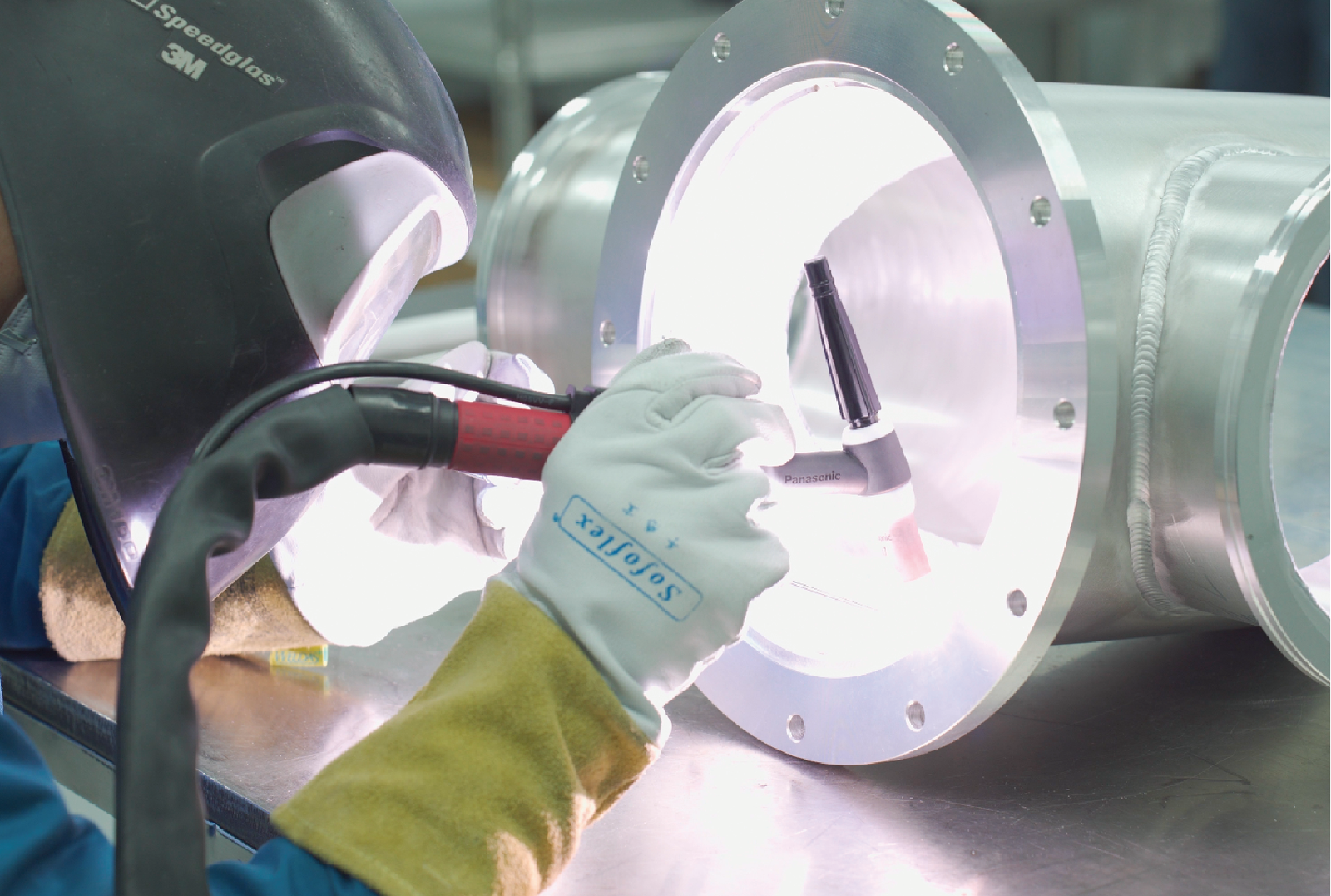
Three challenges dominate. Outgassing of water and hydrogen from the walls is reduced by bakeout, low-outgassing metals and careful cleaning. Permeation of gas through seals and some materials is avoided with metal seals and all-metal construction. Microscopic leaks, including weld defects and trapped volumes known as virtual leaks, are found by helium leak testing and prevented with vented screws and clean welds.
UHV supports particle physics, surface science, advanced materials research and semiconductor research. It costs more and takes longer than any lower level, so it should be chosen deliberately.
Rough Vacuum vs. High Vacuum vs. UHV: Key Differences
The three levels differ in almost every part of the system, and each step down multiplies the demands on design and operation. Use the table below to place an application quickly.
Table 1: Key differences between different levels of vacuum
| Feature | Rough vacuum | High vacuum | Ultra-high vacuum |
|---|---|---|---|
| Typical pressure | Atmosphere to 1 mbar | 10⁻³ to 10⁻⁷ mbar | Below about 10⁻⁹ mbar |
| Gas flow | Viscous (fluid-like) | Molecular | Molecular |
| Main pumps | Rotary vane, dry scroll, diaphragm | Turbomolecular or diffusion, plus backing pump | Ion, NEG, turbomolecular |
| Chamber materials | Aluminium, steel, some plastics | Stainless steel, aluminium, glass | Low-outgassing stainless steel |
| Seals | Elastomer O-rings | Elastomer or metal | All-metal (copper gaskets) |
| Pump-down time | Seconds to minutes | Minutes to hours | Hours to days, including bakeout |
| Maintenance | Oil or filter changes | Pump service, leak checks | Bakeouts, leak checks, pump replacement |
| Equipment cost | Low | Medium to high | Highest |
| Operational complexity | Simple | Moderate | High; trained operators |
| Typical applications | Packaging, drying, degassing | Microscopy, thin films, surface analysis | Particle physics, surface science, semiconductor research |
How to Choose the Right Vacuum Level
Determine first what kind of pressure is necessary for the application or process, and then consider the other considerations. Afterward, consider the following factors: sensitivity to contamination and acceptable residual gas, chamber size and anticipated outgassing, acceptability of elastomer seals, pump-down time and throughput, operating and maintenance expenses. With each reduction in pressure, each of these increases dramatically.
Table 2: A simple decision guide to select vacuum level
| If your process needs | Choose | Reason |
|---|---|---|
| Removal of bulk air, moisture or dissolved gas | Rough vacuum | Low cost, fast cycles |
| A long mean free path for beams or evaporated material | High vacuum | Molecular flow, moderate cost |
| Clean coatings and routine surface analysis | High vacuum | Usually sufficient |
| A clean surface held for long measurements | UHV | Slow monolayer formation |
| Very low background gas for accelerators or sensitive instruments | UHV | Lowest residual gas |
Picking UHV when high vacuum would do the trick increases expenses without enhancing performance. It lengthens pump-down times, uses metal seals, and increases bakeouts without improving the process in any way.
Conclusion: Matching Vacuum Performance to Application Needs
Rough vacuum removes bulk gas cheaply, high vacuum opens a clear path for beams and coating material, and ultra-high vacuum keeps surfaces clean long enough for sensitive measurements. Each step to a lower pressure demands more specialised pumps, better materials and stricter contamination control.
To achieve the best vacuum, do not go for the lowest setting possible. The one that minimizes complexity and costs while meeting the measurable process requirements is the one that comes out on top. Determine the necessary pressure and allowable residual gas before deciding on the appropriate equipment.