
Introduction
High-vacuum manufacturing demands advanced technology. In these systems, even microleaks can be costly, leading to loss of time and valuable process resources. At Laiku, we understand this crucial issue; that's why our engineers optimize strategies to perform reliably under the most demanding technical conditions. Helium leak detection is widely regarded as the gold standard to verify the reliability of high-vacuum chamber manufacturing. Let's dive in to see how it works, why it is preferred, and what solutions we opt for to overcome challenges in helium leak detection.
Why Does Vacuum Integrity Matter?
High vacuum levels range from 10⁻¹ to 10⁻⁵ Pa, whereas for ultra-high vacuum, it critically drops to 10⁻⁷ Pa. In these environments, free gas molecules must be completely eliminated.
For example, in semiconductor processing, maintaining ultra-high purity is essential to ensure atmospheric contaminants do not enter the chamber. Additionally, there are two types of leaks that manufacturers have to cope with. These are rare and virtual leaks.
These reasons lead to opting for methods like helium leak detection that work exceptionally well for highly sensitive environments.
Why Is Helium Preferred for Leak Detection?
This question is critical. Why may you opt for helium over other gases?
It is important to note that helium possesses some unique properties best for vacuum leak detection. These are:
- High tendency of helium to penetrate through micro leaks.
- It is inert. So it does not trigger reactions with vacuum chamber material or surface components such as stainless steel or aluminium.
- It is highly diffusive. This means that it rapidly travels through complex-shaped components and detects leaks quickly.
Two Fundamental Approaches to Helium Leak Detection
There are two main approaches to helium leak detection methods for high vacuum and ultra-high vacuum chamber manufacturing. Each has its own perks and limitations that must be considered.
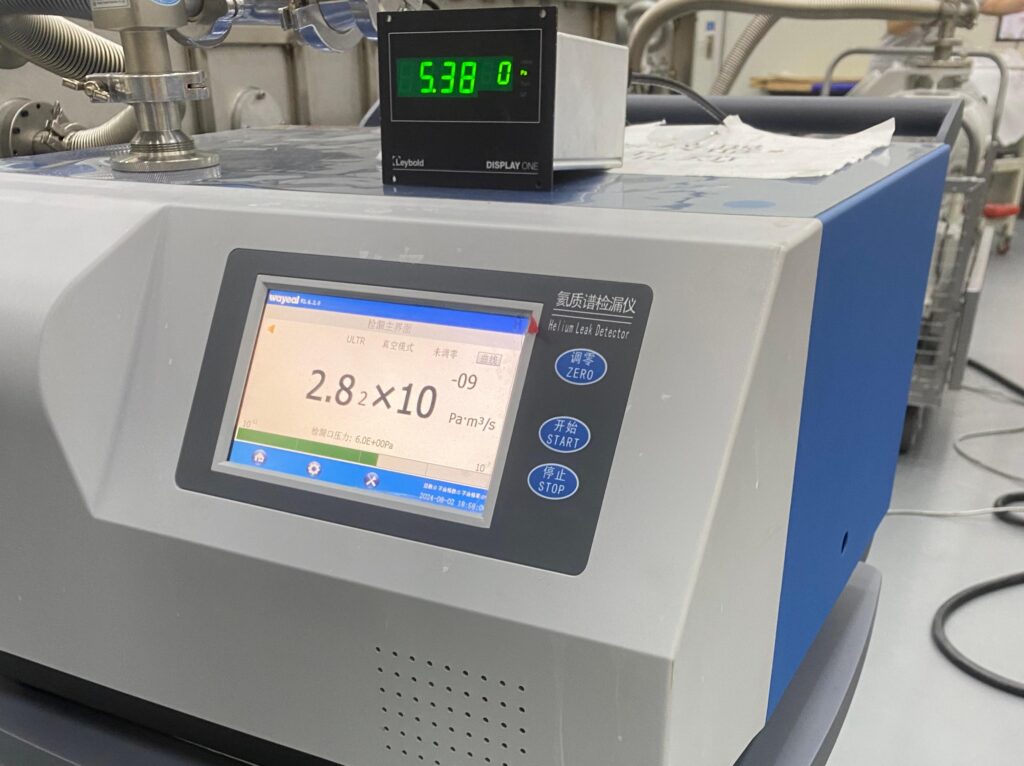
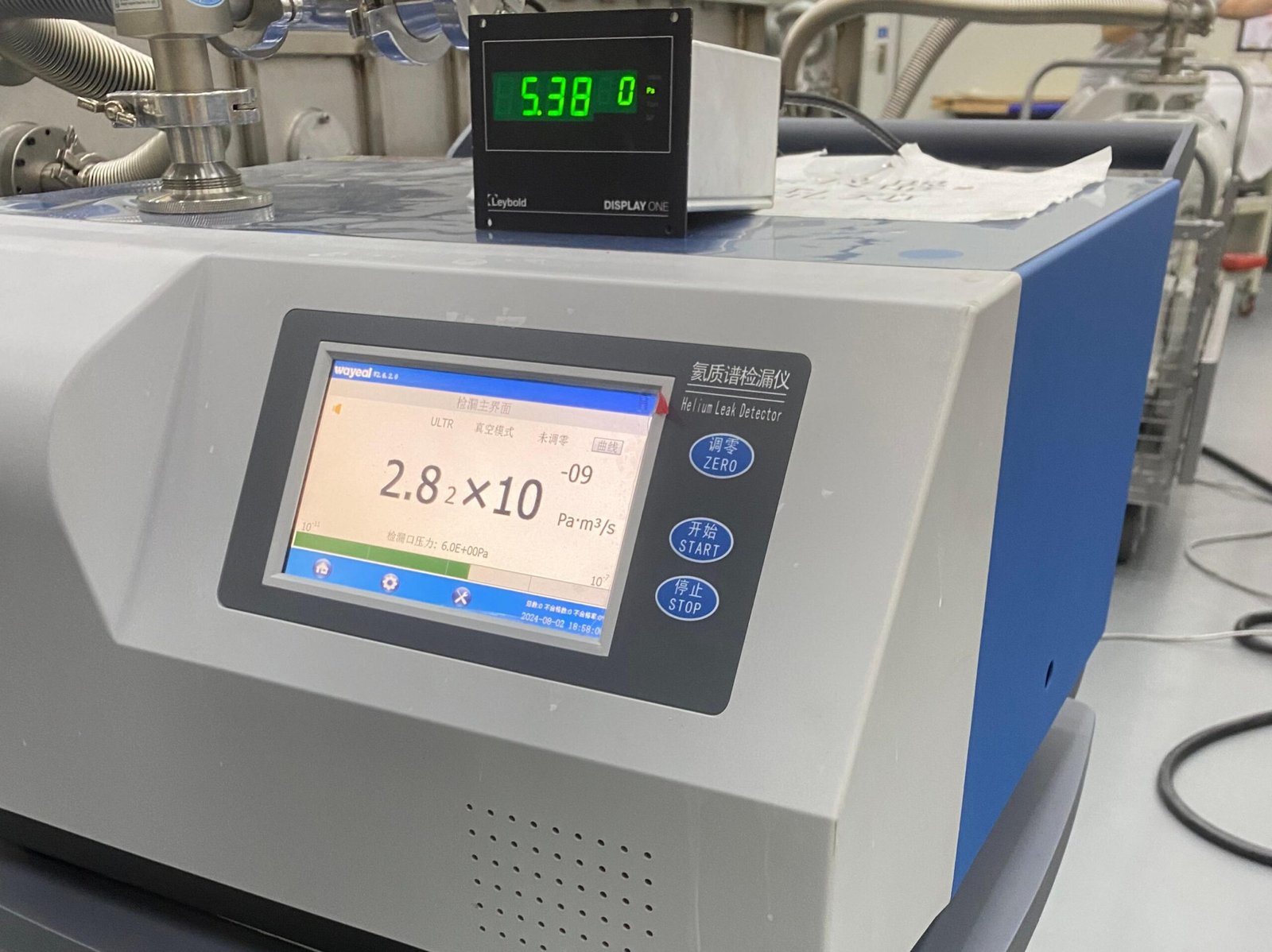
Helium leak detection setups primarily utilize a Helium Leak Detector (HLD)—a specialized system integrating turbo-molecular pumps with a sector-field mass spectrometer calibrated explicitly for the atomic mass of helium-4 (m/z = 4).
Depending on the geometry and design of the high-vacuum component, testing is typically executed via two standard methodologies:
1. The Vacuum Method (Outside-In)
The leak detector pumps down the inside of the chamber to create a vacuum. Engineers then spray a small stream of helium gas onto the exterior seals, welds, and joints. If a leak exists, the vacuum pulls the helium inside. The mass spectrometer immediately measures the exact leak rate.
Advantages:
- Extreme Sensitivity: Detects microscopic leaks down to 10⁻¹³ Pa·m³/s
- High Speed: Delivers fast, automated results ideal for high-volume production lines.
- Quantifiable Data: Measures the exact overall leak rate of the entire part.
Limitation:
- High Equipment Cost: Requires expensive vacuum pumps, chambers, and fixtures.
- Part Stress: Parts must withstand high internal vacuum without collapsing or distorting.
- No Leak Location: Identifies if a leak exists, but not the exact physical spot.
2. The Sniffer Method (Inside-Out)
Engineers fill the test part with pressurized helium gas. They move an external probe ("sniffer") slowly across the outer seams. The probe samples the air. If helium escapes from an internal joint, the detector registers the leak and pinpoints its location.
Advantages
- Exact Leak Location: Pinpoints the precise physical spot where gas is escaping.
- No Vacuum Needed: Ideal for large, fragile, or flexible parts that cannot handle vacuum.
- Lower Initial Cost: Requires simpler, more affordable equipment with no vacuum chambers.
Limitation
- Lower Sensitivity: Limited to larger leaks, typically down to 10⁻⁸ Pa·m³/s.
- Slower Cycle Times: Relying on manual scanning creates production bottlenecks.
- Operator Dependent: Human error during scanning can lead to missed leaks.
Which one works best for your project?
For ultra-high precision demands like semiconductor facilities, the vacuum method is overly dominant and presents a standard for wide engineering solutions. The sniffer method can be used for other applications, including secondary repair stations or testing massive facility gas pipelines.
How Quality Manufacturing Prevents Vacuum Leaks?
Detecting a leak is helpful, but preventing them entirely requires premium fabrication standards. High vacuum chambers must be engineered to prevent both real and virtual leaks.
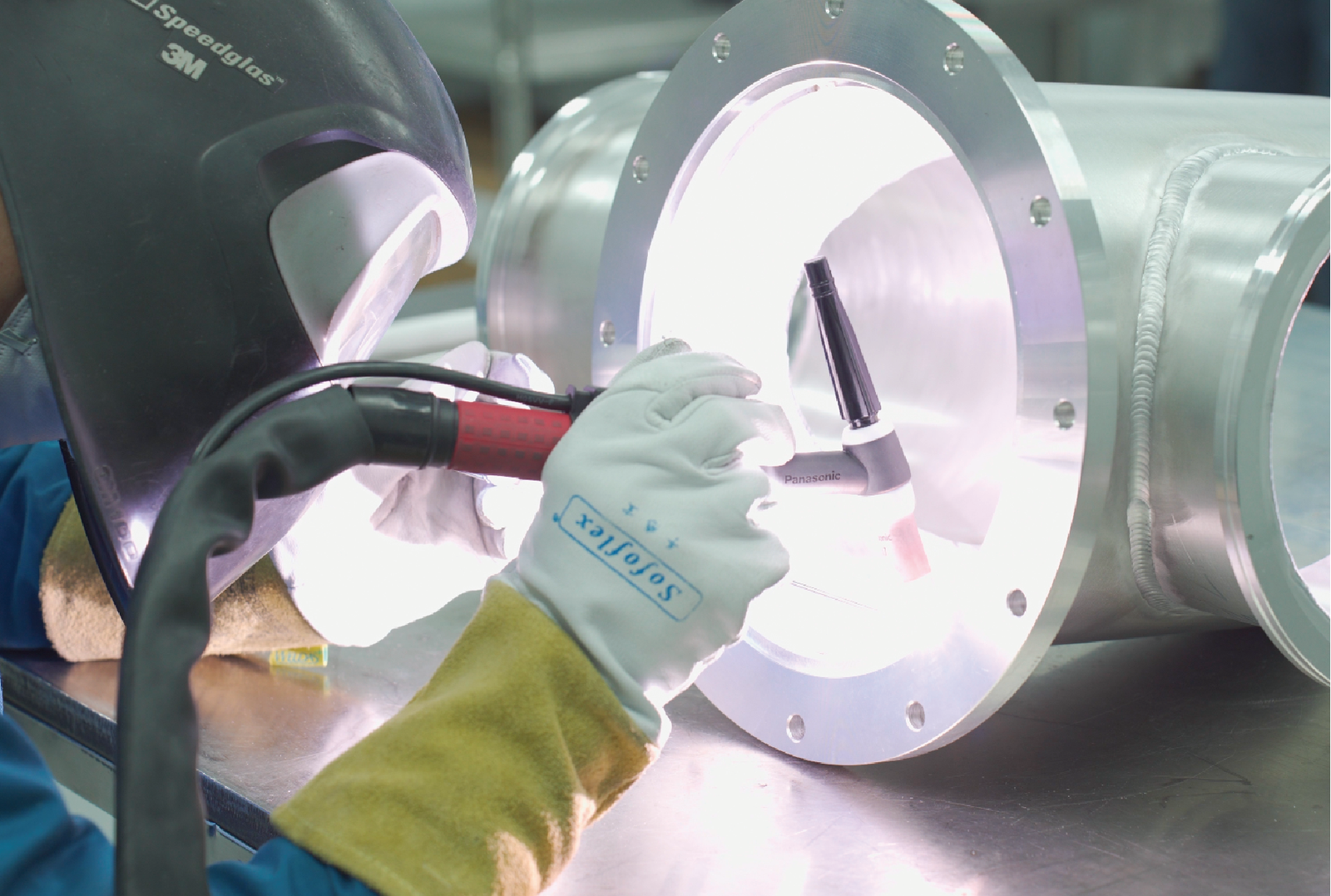
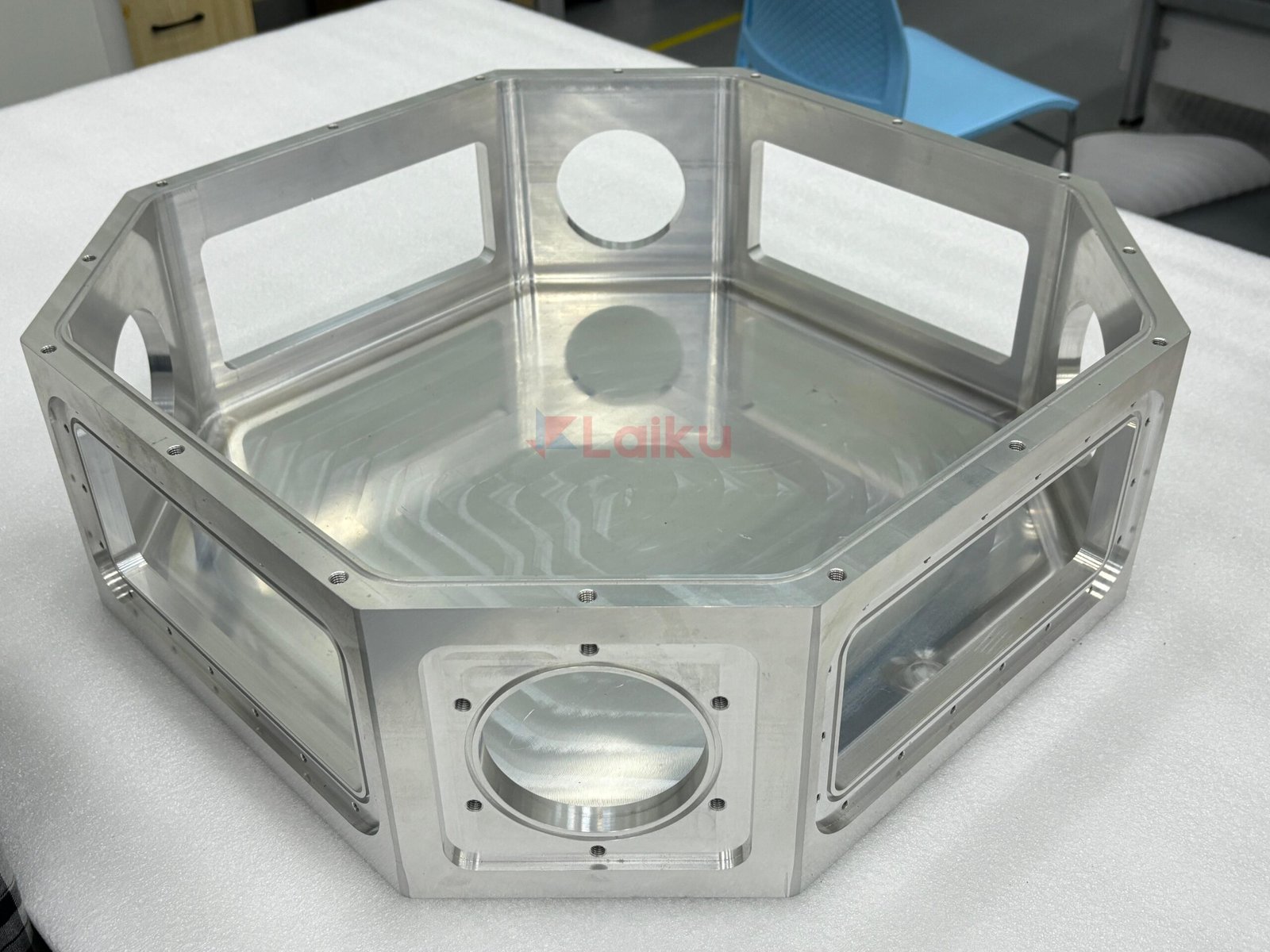
Achieving a stable vacuum seal down to 10⁻¹² Pa·m³/s demands strict control over CNC machining, welding, and cleanroom assembly.
Common Challenges in Helium Leak Testing and How to Overcome Them
Here are the most common challenges in helium leak testing and how we help you overcome them.
High Helium Background (Helium Signal Drift)
Helium from previous tests or ambient air builds up in the testing area. This creates a high background signal that masks real, microscopic leaks.
At Laiku, we optimize your system with dedicated background suppression cycles and engineered ventilation. We design smart purging sequences to clear residual gas before the next test begins.
Gross Leak Failures and Contamination
Large leaks overwhelm mass spectrometers, flooding the system with helium. This causes long downtime while waiting for the sensor to clear.
We implement a two-stage testing protocol. We first run a gross leak test using pressure decay or mass flow. If the part passes, we then introduce helium for fine leak testing.
Temperature and Environmental Fluctuation
Temperature swings alter gas density and pressure. This variation causes unstable leak rate readings and inconsistent data.
We engineer environmental controls and software-driven temperature compensation into your testing process. This ensures stable, highly repeatable data regardless of factory floor conditions.
Part Cleanliness and Outgassing
Surface moisture, oils, or residues outgas under a vacuum. This mimics a leak and prevents the system from reaching the required vacuum level. We analyze and optimize your pre-test cleaning protocols. We ensure parts are thoroughly dried and degreased to eliminate outgassing variables completely.
Summing Up – Ensure high standards with Laiku!
In high vacuum manufacturing, helium leak detection is the ultimate safeguard for process stability. Finding micro-faults in HV and UHV chambers during manufacturing before it goes live protects manufacturing environments, boosts production yields, and reduces expensive downtime. Achieving this level of vacuum reliability requires an experienced manufacturing partner. Through large-scale CNC milling, expert welding, Class 100 cleanroom assembly, and strict testing protocols, Laiku delivers high-integrity vacuum chambers that stand out for modern industrial demands. For more information, contact us now.